© Armands Kaušelis

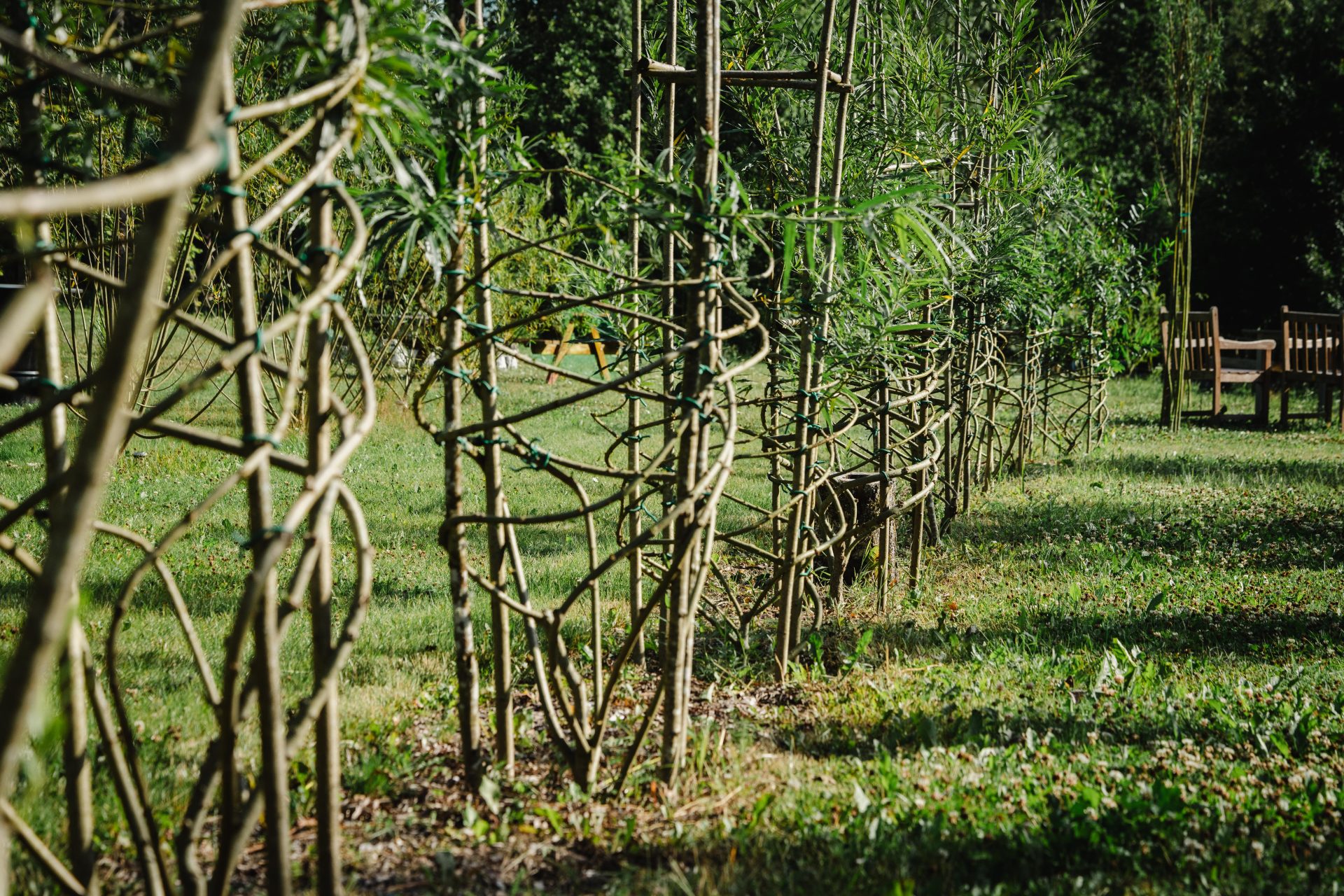
“I believe that one day this place will be teeming with tourists like the Eiffel Tower,” says Katrīna Knese-Šmite, manager of Forest Designed, the only furniture farm in Northern Europe. Here, years of dedicated manual labor shapes trees into functional pieces of furniture and art. In five to 10 years the farm will be a veritable outdoor gallery, brimming with unique hand-crafted pieces. Some will be harvested to support Latvia’s wood furniture exports, which in 2025 totaled 202.654 million euros and accounted for 6% of all wood product exports*. Others will be replanted in urban settings, where they will take on new life as living sculptures. Already now, the farm welcomes curious visitors keen to witness the tree-shaping process.

0/5 (0 Reviews)

© Forest Designed

© Forest Designed

When chief tree-shaper Uldis Šmits and wife Katrīna moved to rural Cīrava parish in 2020, Uldis had planned to work in carpentry, but a certain global pandemic put a stop to his plans. Around then he also realized that he needed to find a niche. By chance, he saw a TV story on tree-shaping, and the idea was born. While Katrīna was skeptical, thinking that the idea lacked long term business potential, the couple discovered that very few people in the world specialize in tree-shaping and so it could prove to be a fruitful venture. As luck would have it, the worldwide shutdown proved to be a good time for experiments, and tree-shaping didn’t require large investments to get off the ground. What’s more, the endeavor would be largely unaffected by rising utility costs.

0/5 (0 Reviews)

© Forest Designed

© Forest Designed

© Forest Designed

“You often see passion projects turn into businesses. For us, it was the other way around. We started with a business plan. I thought we’d be planting 500 chairs a year and said that I wouldn’t lift a finger without the promise of any income. However, it’s gone from being a business plan that didn’t come to fruition to being a true labor of love and our life’s work,” Uldis shares of their first steps and journey since then. In his words, tree-shaping is like using the land as a 3D printer. Katrīna also instantly recognized the idea’s potential for attracting tourists.

Originally, they began shaping willow trees as instructed by a tree shaper from England who they’d approached online. Fast forward to today, however, and you’ll find the farm full of sycamore maples – trees that are much more suited to shaping furniture. This is just one piece of valuable intel that Katrīna and Uldis learned from Peter Cook, an authority in tree-shaping who they spent a week with on his property in Portugal. Again, this exchange was the result of simply reaching out to the right person online.

0/5 (0 Reviews)

© Forest Designed

© Forest Designed

© Forest Designed

“Essentially, we started from scratch in 2024. After returning from Portugal, we changed the type of tree and our approach and neglected most of our original pieces,” Katrīna explains, adding that some of the willow pieces, like a lampshade, did turn out quite nicely, are still a first for Latvia and so impressive enough.

The couple attributes much of their success to their daring spirit, undying enthusiasm and drive. She also underscores the importance of believing in your idea: “You must let your idea take its own course. We obviously work hard but see where the idea takes us, and it’s led us onto better paths than we’d expected.”

0/5 (0 Reviews)

© Forest Designed

© Forest Designed

© Forest Designed

Tree-shaping and the products that they’ve created around it are the perfect outlet for their skills and experience. Katrīna has a background in events, marketing and tour guiding, while Uldis is a professional cook, a business graduate and an arborist.

“What we’re growing is our pension fund – an investment into the future. It will still take five to 10 years of solid work to get to an excellent result,” says Uldis of their labor of love, adding “I used to think I could grow Christmas trees. They take seven years to grow as well! But then you just buy one for 50 euros and throw it away once Christmas is over. This takes much more work, of course, but there is so much more value in it – creative, artistic, technical and financial.”

*According to data from the Ministry of Agriculture.

0/5 (0 Reviews)
Comments (0)