An Unforgettable Experience: The Floating Festival

22.07.2025

Comment (0)

© Ezera Skaņas

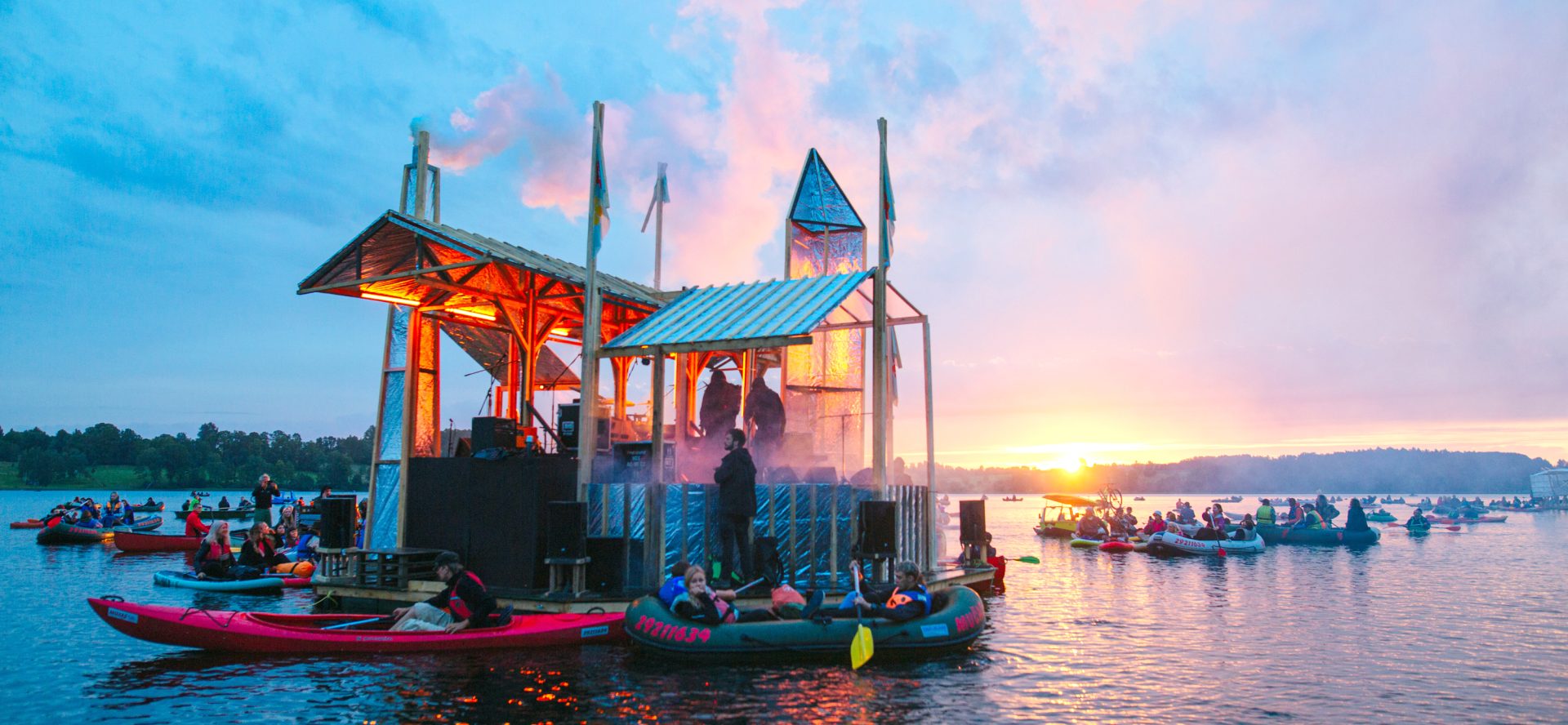
As kids, Reinis and Matīss Spaile, along with Zane Priede, spent their summers playing around, experimenting, and building on their family’s property by the shores of Lake Kāls. Today, they channel that same creative energy into Ezera skaņas, an annual festival that has evolved from a one-night floating event into a three-day experience — beginning on the lake at night and continuing on land.

The trio remained close through their university years — Reinis and Matīss studied film, while Zane pursued design — and continued their tradition of lakeside summers, inviting friends to join them. Their gatherings grew into informal camps and workshops, further transforming  and enhancing the site, with everyone contributing their skills and talents. Over time, they identified a strong narrative and the makings for a potentially powerful scenography: the dark lake and the gradual arrival of light. That vision became the foundation of what would become Ezera skaņas, first launched publicly in 2012.

“Initially, we had this anti-festival stance. As keen festivalgoers ourselves, we wanted to see how we could change the concept,” explains Reinis. “We didn’t announce any of the artists and ensured anonymity in order to shed our old and acquired identity, find something new, keep communication minimal, and limit any advertising.”

“The artists’ task wasn’t to entertain the attendees but to work with the environment and sunrise,” he continues, adding that one of their key interests with the festival is to communicate their values and ideas. “The word ‘festival’ has a negative connotation to it because it’s associated with vast amounts of alcohol. Fortunately, there are also many positive examples, and we want to work on that festival culture.”

© Ezera Skaņas

© Ezera Skaņas

Reinis shares that both the artists and the attendees appreciate the mysteriousness and the unknown. “The first few years saw a major boom in popularity. It was shocking! The festival grew from 20 to 200 to 1000 and even 5000 attendees! At that point, we realized that this isn’t good for the environment and that to grow to a certain size shouldn’t be our goal because it takes something away from the experience.” Now, ticket numbers are limited.

A key part of Ezera skaņas is the camp that takes place in the run up to the actual festival. This is where most of the scenography elements are born. Today, the organizers both invite selected individuals and issue an open call for participants. In 2025, they received around 200 applications for 85 places! In their motivation letters, applicants indicate their keenness to work on something with their hands and collaborate. Reinis underscores the importance of gathering participants from very different walks of life since such diversity is key to the most fruitful collaborations and creativity.

“Every year, we define a keyword or concept to work with. Last year, it was ‘I’m looking at a fuzzy cloud’, which was centered around the idea of the water rippling in the morning. Camp participants worked on abstract textures and structures, playing with the idea,” Reinis elaborates.

© Ezera Skaņas

© Ezera Skaņas

Today, Reinis uses the term “community festival” to describe their approach. Attendees back the event with their ticket purchases, along with the vital support of the Madona Municipality and sponsors.

Every year, they place more and more focus on the local area. Originally, this involved visiting every land owner around the lake to present the festival concept and coordinate access to the lake’s waters. Now, the Ezera skaņas team hopes that the festival might be the spark that people need to visit the region and its small businesses, such as the Labrīt goat farm and many others. Having researched the history of the area, they’ve discovered that the nearby village of Vestiena was once known as Festen (the German word for parties or celebrations) and that open-air parties historically took place here too, on an island in the lake.

Reinis is grateful to everyone who chooses to attend Ezera skaņas, highlighting that attendees become co-creators of the experience. “Some people go alone, which seems beautiful, and then you have groups of 12 people in big rubber boats, enjoying their own mini festival. I have so much respect for the energy each person invests!” he concludes. After all, to take part in the event takes either staying up very late or waking very early to slip into the water before sunrise.

Comments (0)